The Response Spectrum analysis (RS analysis) allows
getting the maximum value of forces, displacements and base reactions of a
structure, starting from a design spectrum defined in terms of period (T) vs. pseudo-accelerations (Sa). The design spectrum is usually
given by design codes.
The equation of motion involves the mass matrix  , the stiffness matrix
  and the damping matrix
  .
.
 (1)
(1)
In Eq. 1,  is the displacement vector we want to find as solution of the
system,
is the displacement vector we want to find as solution of the
system,  is the dragging
vector, which specifies for which spatial directions the external ground
acceleration
is the dragging
vector, which specifies for which spatial directions the external ground
acceleration  is applied.
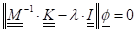
The base for the space of all the possible
configurations can be described by linearly combining the eigenvectors  that can be extracted
from the system
that can be extracted
from the system
 (2)
(2)
being  the square of the
cyclic frequency for each mode, and
the square of the
cyclic frequency for each mode, and  the identity matrix.
Hence, the displacement can be written in terms of the
product between the matrix collecting all the normalized eigenvectors  and the modal
coordinates
and the modal
coordinates .
.
 (3)
(3)
By using Eq. 3 in Eq. 1, we get:  (4)
(4)
By
multiplying both members by ΦT
we get:
 (5)
(5)
 (6)
(6)
Where C*
is the modal damping matrix, Ω is called spectral matrix and Γ is the vector containing the participation
factors.
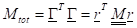
The mass
excited by the motion is:
 (7)
(7)
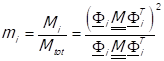
The
participation factor is the ratio of the excited mass over the total mass of
the system:
 (8)
(8)
The mass excited in the i-th mode is:
 (9)
(9)
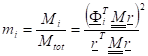
Then, the
percentage of the mass in Eq. 9 would be:
 (10)
(10)